
Qaitbay Citadel: Alexandria’s Seafront Fortress & Visit Guide
Qaitbay Citadel gives Alexandria one of its most distinctive waterfront landmarks: a stone fortress facing the Mediterranean, with a story that reaches back to the site of the ancient lighthouse. Also called the Citadel of Qaitbay or Qaitbay Fort, it brings together military architecture, maritime history and the atmosphere of Egypt’s northern coast.
This guide from New Belquis Tours explains what to notice, how to understand the lighthouse connection and how to make the citadel part of a rewarding Alexandria visit.
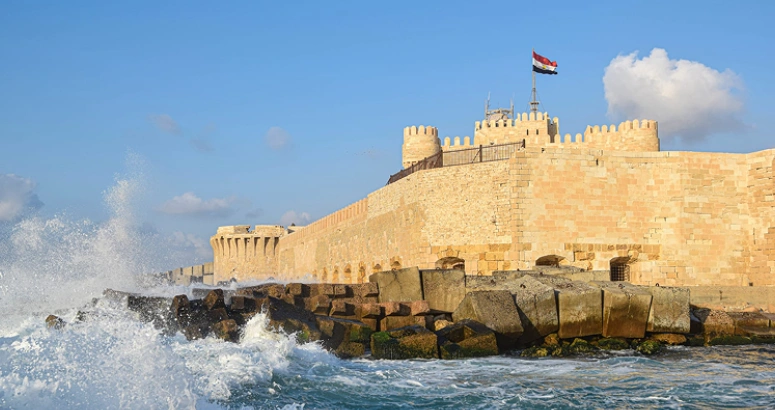
Qaitbay Citadel History: From Lighthouse Site to Fortress
The Mamluk sultan al-Ashraf Qaitbay built the citadel between 1477 and 1479 on the ruins of Alexandria’s ancient lighthouse. Its purpose was defensive: protecting the city against attack from the sea. The surviving fortress belongs to the medieval city, rather than to the age in which the lighthouse itself was built.
That distinction is useful when you visit. You are exploring a Mamluk fort on a much older and historically important site. Let the setting prompt two separate questions: why was this location important to ships, and why did a later ruler choose it for defence?
What to Look for Inside the Citadel
The Main Tower and Defensive Layout
The limestone complex has outer defences, an inner courtyard and a main square fort with rounded corner towers. Its three-storey main tower helps you understand how the building was organised for protection and the practical needs of its garrison.
Move through the spaces slowly and look at how walls, openings and changes in level relate to one another. Instead of seeing the fort as a single block of stone, try to read it as a working structure: places for observation, movement, shelter and storage.
The Visitor Centre
A visitor centre within the main tower introduces the area’s historical and architectural development. The Ministry of Tourism and Antiquities describes bilingual Arabic and English panels, maps and a film about the ancient lighthouse site. It is a useful place to seek context before exploring the architecture, subject to access on your visit date.
The Mediterranean Setting
Leave time to appreciate the relationship between the fortress and the sea. The waterfront makes the defensive purpose easier to imagine, while offering a different visual experience from the monuments of Cairo and Luxor. Use designated visitor areas and follow any restrictions around exposed edges or closed routes.
The Lighthouse Connection: What Survives?
The connection is the location: the citadel was constructed over the ruins of the Lighthouse of Alexandria. The fortress you see today should not be described as an intact ancient lighthouse. Keeping the two stories distinct makes both more interesting.
Ask your guide to explain the changing role of this part of Alexandria, from a place associated with navigation to one designed for military defence. The visitor information can help you picture those changes without confusing a later reconstruction, interpretation or image with the original structure.
How to Plan an Alexandria Citadel Visit
As an itinerary suggestion, allow a relaxed visit rather than treating the fortress as a brief exterior photo stop. Your ideal duration depends on how much time you want for the architecture, interpretation and waterfront. Check current admission, access and opening arrangements before travelling.
- Allow for the weather. Coastal wind and sun can affect comfort, so dress for the conditions and bring sun protection.
- Choose comfortable footwear. Ask about steps, uneven surfaces and accessible routes if these affect your visit.
- Plan photographs thoughtfully. Leave room for the sea and the overall shape of the building, and follow all posted photography rules.
- Keep your route flexible. Do not assume every tower, level or room will be accessible on the day.
- Make transport arrangements clear. Agree on your arrival and collection points before exploring the waterfront.
Combining Qaitbay Citadel with a Wider Egypt Trip
A day in Alexandria can provide a welcome change of setting within a longer cultural holiday. Choose a small number of city stops that match your interests and leave time between them. If travelling from Cairo, discuss the full journey with your planner before deciding how many visits to include.
The Saladin Citadel in Cairo offers an interesting comparison: another major fortress, with a different landscape and historical development. Museum lovers can also explore our guides to the Grand Egyptian Museum and NMEC when planning their Cairo days.
Qaitbay Citadel: Frequently Asked Questions
Where is Qaitbay Citadel?
It is in Alexandria, on the Mediterranean waterfront at the site associated with the ancient Lighthouse of Alexandria.
Who built the citadel?
The Mamluk sultan al-Ashraf Qaitbay commissioned the fortress in the fifteenth century.
Is the citadel the ancient Lighthouse of Alexandria?
No. It is a medieval fortress built over the lighthouse’s ruins. The standing fort and the ancient lighthouse belong to different periods.
Can I visit every level?
Access can vary. Check current arrangements and ask the site team about the routes open to visitors, especially if steps are a concern.
Plan Your Alexandria Visit with New Belquis Tours
Tell New Belquis Tours how Alexandria fits into your Egypt holiday. Whether you prefer maritime history, architecture or a varied cultural route, share your interests and travel dates so the visit can be planned at a comfortable pace. Find more ideas in our Egypt travel blog.
Official Sources
- Ministry of Tourism and Antiquities: Qaitbay Fort
- Ministry of Tourism and Antiquities: Qaitbay Visitor Centre
For the coastal setting and conservation context, see the Ministry of Water Resources and Irrigation: Qaitbay Citadel project.